Accelera 300 Heat Pump Water Heater by Stiebel Eltron
the world's most efficient Energy Star rated heat pump water heater!

Let us help you evaluate if a heat pump water heater is right for your application. Call us now...

Stiebel Eltron
Accelera 300 Brochure
Adobe PDF Format

Stiebel Eltron
Accelera 300 Installation Guide and Owner's Manual
Adobe PDF Format

the Stiebel Eltron Accelera 300 heat pump water heater is independently tested to comply with both US and Canadian safety standards
Stiebel Eltron is 
Quality you can count on!
Manufactured in Germany
Discontinued
Stiebel Eltron Accelera 300 |
The Stiebel Eltron Accelera 300 has been replaced by the Stiebel Eltron Accelera 300 E which features: Higher Energy Star Energy Factor Impressed current anode - Click here for more info - |
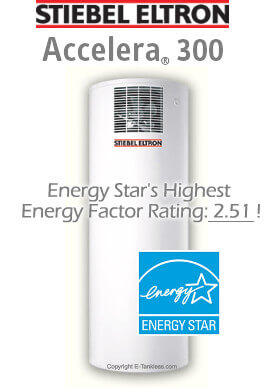
The Stiebel Eltron Accelera 300 is the most efficient heat pump water heater presently rated by the Energy Star program in North America. Energy Star rates energy efficiency using a measure called the "Energy Factor." The
Energy Factor is the ratio of useful energy output from the water heater to the total amount of energy delivered to the water heater and it is measured in accordance with strict standards so consumers can compare the efficiencies of one model to another. The Stiebel Eltron Accelera 300 boasts an Energy Factor of 2.51, significantly higher than any other Energy Star rated heat pump water heater. In addition, the Accelera 300 features the lowest operating costs, the largest storage tank, one of the highest first hour ratings, and one of the longest warranties, making it the best value on the market today.
- Energy Star rated
- reduce water heating cost by up to 80%
- industry-leading efficiency
- 80 gallon storage capacity
- back-up booster element
- cools and dehumidifies air around it
- low heat loss through superior insulation
- sacrificial anode
- meets all U.S. & Canadian safety standards
- 10-year warranty
Heat pump water heaters are the latest water heating technology to emerge in the North American market. While heat pumps have been efficiently heating the air in our homes for decades, it is only recently that the same technology has been integrated into relative compact and highly efficient water heating systems for both residential and light commercial applications. The efficiency of a heat pump water heater typically exceeds 200%! Accordingly, they cost less than half as much to operate as a conventional tank-type water heater.
A heat pump does not generate heat like a conventional water heater. Rather, it "pumps" or transfers heat from one area to another by alternatively compressing and decompressing a refrigerant as it passes from one area to another. In the case of a heat pump water heater, it transfers heat from the air surrounding the heater into the water inside its tank. Since only a small compressor motor, pump, and fan are required, the process is extremely energy efficient!
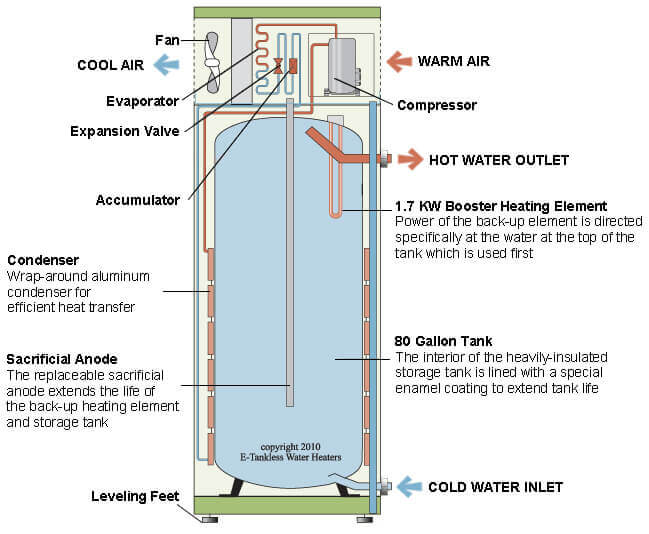
The Accelera heat pump water heater features a enamel-lined storage tank with a very high level of foam insulation for low stand-by heat loss. A 1.7 KW back-up electric heating element is integrated into the unit to deliver extra heating power in the event that the heat pump is unable to draw sufficient heat from the air surrounding the unit to meet short-term peak water demands. To save energy, the booster heater only heats the top third of the tank (approx. 27 gallons). The tank and heating element are protected from corrosion by a sacrificial anode thereby extending service life. A thermostat automatically switches the booster heater on if the water temperature inside the tank falls below 112F (45C).
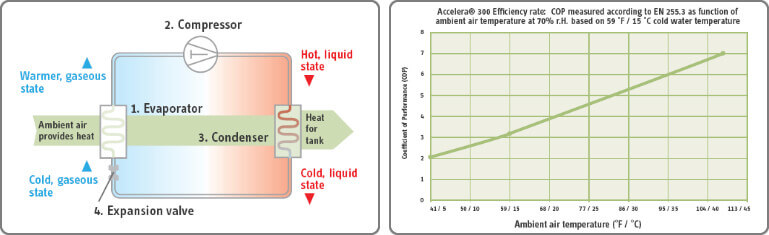
Like all heat pump water heaters, the warmer the ambient air temperature, the more efficient the Accelera 300 will be. The Accelera's compressor and fan consume only 1kWh of electricity to generate the heat equivalent of 3 to 5kWh during most conditions. For instance, the coefficient of performance at 70% relative humidity, 59F incoming water temperature, and normal room temperature (~70F) is approximately 4 and will rise to 6 at a room temperature of 95F (see graph below). Accordingly, the Accelera is more efficient in warmer climate zones and perform best where the average year-round temperature exceeds 40F. In a warm climate, the unit can either be placed in the garage or attic where it takes excess heat from the ambient air, or inside the house, where it helps with the air conditioning load. In a cooler climate, the unit is typically placed in the basement where it also acts as a dehumidifier. You get hot water at a discount and a dry basement as well.
How a heat pump water heater works...
The heat pump system contains a fan that forces air through an evaporator (1). The evaporator contains a liquid refrigerant. This refrigerant evaporates and absorbs heat from the ambient air. The now warm, gaseous refrigerant is then compressed by the compressor (2) which is driven by an electric motor. As it goes through the compressor, the pressure and temperature rises. The refrigerant turns back into a liquid which is now hot. The refrigerant then passes through the condenser (3), which is wrapped around the water tank, and transfers its heat to the water inside the tank. The now cooler refrigerant then passes through an expansion valve (4), where it transformed back into a gaseous state and the process begins again.
| Stiebel Eltron Accelera 300 Heat Pump Water Heater Specifications |
|
|---|---|
| Energy Factor: | 2.508 |
| Coefficient of Performance (COP) (t): | 3.18** |
| COP Typical Range: | 3 to 6 |
| First Hour Rating: | 78.6 gallons |
| Operating Air Temperature Range: | 42 - 108F / 6 - 42C |
| Temperature Setting: | 140F (60C) |
| Air Flow Rate: | 324 CFM |
| Sound Level at 1.1 Yards: | 64.2 dB |
| Tank Capacity: | 80 gallons / 303 L |
| Refrigerant: | CFC-free R134a / 900 grams |
| Dimensions: | 74" H x 26" Dia (188 x 66 cm) |
| Dry Weight: | 287 lbs (130 KG) |
| Wet Weight: | 952 lbs (432 KG) |
| Water Connections: | 3/4" NPT |
| Operating Pressure: | 87 psi (0.6 MPa) |
| Electrical: | Single Phase / 220-240V / 60 Hz |
| Maximum Power Draw: | 2.2 KW |
| Breaker Required: | 15 AMPS* |
| Safety Certification: | ETL Listed (US/CAN) |
| Protection: | Temperature & Pressure (T & P) relief valve included, internal high limit thermostat |
| Manufacturer Warranty: | 10 years |
* Breaker size and wire gauge must meet all applicable local, state, provincial, and national electrical codes for your area - these are only guidelines that will apply to most installations. Please consult your electrician for more details.
** Test point at 59F / 15C air temperature, 70 % relative humidity, heating up water from 59F / 15C to 140F / 60C (according to EN 255 T3, 240 V / 60 Hz)
Important Heat Pump Installation Considerations:
The Accelera 300 and other heat pump water heaters should not be installed in a location where the ambiant air temperature regularly drops below 42F (6C) or exceeds 108F (42C). Since the Accelera takes heat from the air around it, it is most desirable to install it in an area with excess heat such as a garage or attic in warm climate areas. In colder climates, the Accelera can be installed in a basement where it will help dehumidify the air. It is important to ensure that there is a sufficient volume of air around the unit for effective heat extraction and optimal efficiency. There should be approximately 1,000 cubic feet air in the installation room, and not less than 500 cubic feet unless ducting is provided to bring in more air from another room or location and to exhaust the cool air from the outlet of the heat exchanger. In most cases, a room measuring approximately 10 x 10 ft will be sufficient. When installing the water heater inside, the space where it is installed will generally be cooled down during the operation by 2 to 6F (1 to 3C). Please see the Installation manual for important recommendations regarding physical clearance recommendations to each side of the unit and above (roughly 16" right and left, 8" to back wall, and 16" above unit).
To prevent nuisance from operating noise, never install the water heater in the vicinity of bedrooms. The compressor motor and fan make about as much noise as a refrigerator or small room air conditioner when running.
E-Tankless Water Heaters is one of only two dealers directly authorized by Stiebel Eltron to distribute the Accelera 300 heat pump water heater online. You can be assured that you will not only receive the highest level of pre and post-purchase customer service, including advice with respect to your application, but you will also be backed by a fully valid manufacturer's 10 year warranty if you decide to purchase. Please feel free to contact us toll free at 1-877-374-2696 to speak directly to one of our staff regarding your application.
 U.S. RESIDENTS: Regional incentives for the Accelera® are available in many locations. The U.S. Department of Energy's Database of State Incentives for Renewables & Efficiency website has up-to-date details at: http://www.dsireusa.org/.
Please Note: Please review our store policies, particularly the return policy as it relates to the Accelera 300, before ordering.